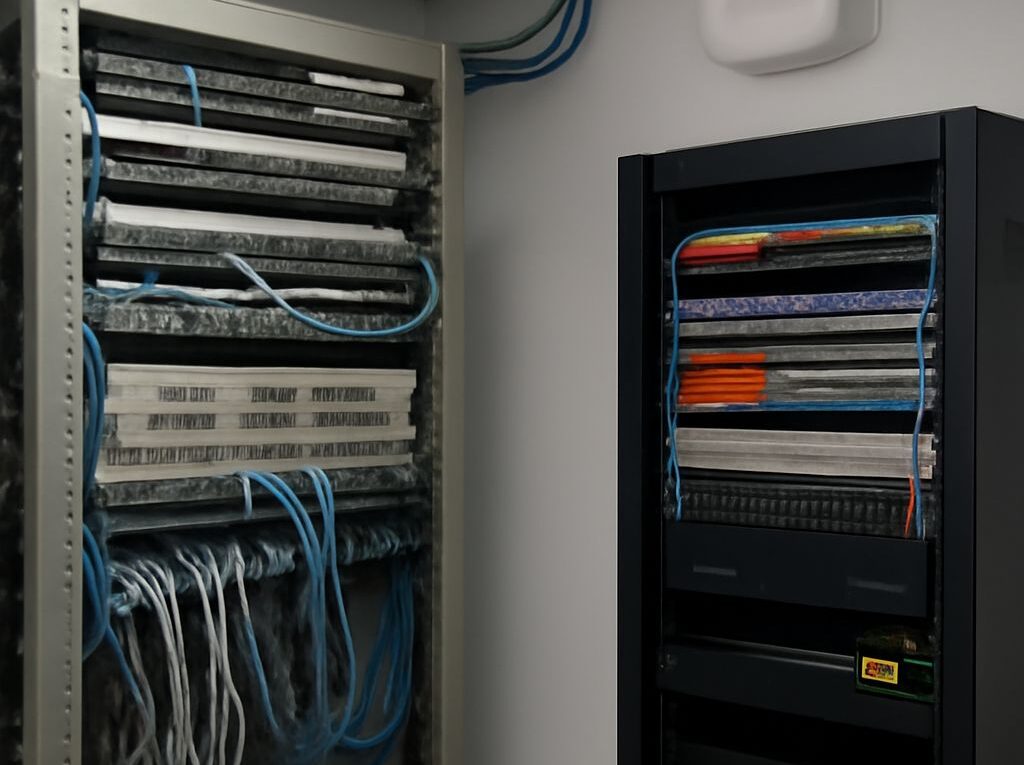
What Is an IDF Closet? Understanding Its Role in Network Cabling
An IDF closet, or Intermediate Distribution Frame closet, is a dedicated space within a building designed to house telecommunications and network cabling infrastructure. It serves a critical role in modern network design, acting as the intermediary point between the main distribution frame (MDF) and end-user connections. IDF closets are essential for organizing, distributing, and managing wired network connections—such as Ethernet—and facilitating reliable private wireless network access throughout a facility.
Defining an IDF Closet in Modern Networks
An IDF closet is a secure, often climate-controlled room or enclosure where network cables from multiple workstations, wireless access points, and other endpoints converge. Its primary function is to connect these horizontal cabling runs to central network equipment in a structured, manageable fashion. In larger buildings or campuses, several IDF closets are strategically located on different floors or wings to minimize cable lengths and signal degradation.
IDF closets typically serve as the aggregation points for local area network (LAN) segments, relaying data traffic between user devices and the main network backbone. They are not intended as general storage rooms; only authorized personnel should access these spaces to ensure network reliability and security. Well-designed IDF closets help reduce downtime and simplify troubleshooting by providing clear separation and organization of network cabling and equipment.
How an IDF Closet Supports Network Infrastructure
The primary role of an IDF closet is to support the structured cabling system that enables efficient network connectivity across a facility. In Ethernet-based networks, cabling from individual user outlets or wireless access points runs back to the nearest IDF closet. There, these cables terminate at patch panels, which are connected to network switches. The IDF closet then links back to the main distribution frame, often via fiber optic uplinks, ensuring high-speed, reliable communication with the rest of the organization’s network.
For private wireless networks, the IDF closet provides both power and data connectivity to wireless access points deployed throughout the building. By centralizing network equipment and cable management, the IDF closet makes it easier to perform upgrades, add new users, and maintain consistent network performance. It also helps comply with standards such as TIA/EIA-568 for structured cabling and simplifies compliance with security protocols by restricting physical access to sensitive connections.
Key Components Found in an IDF Closet
Several essential components are commonly present in a network IDF closet:
- Patch Panels: These panels provide a termination point for horizontal cabling, allowing for organized cross-connections with network switches.
- Network Switches: Switches aggregate connections from user devices and relay traffic to the main network. They may support Power over Ethernet (PoE) for devices like IP phones and wireless access points.
- Fiber Optic Termination Boxes: In many modern installations, fiber optic cables connect the IDF closet to the main distribution frame, requiring secure termination and patching equipment.
- Uninterruptible Power Supplies (UPS): These provide backup power to maintain network availability during electrical outages.
- Rack Enclosures: Equipment racks or cabinets house and organize hardware, maintaining airflow and physical security.
- Cable Management Systems: Trays, ducts, and rings are used to route and secure cables, preventing tangles and easing maintenance tasks.
Additional items, such as environmental monitoring sensors, grounding systems, and security locks, may also be installed to enhance safety, performance, and compliance.
IDF Closets vs. Network MDFs: What’s the Difference?
Understanding the distinction between an IDF closet and a main distribution frame (MDF) is vital for proper network planning. The MDF is the central hub of a building’s network infrastructure, usually located near the service entry point. It houses the main network switches, routers, firewalls, and connections to external network services such as the internet or wide area network (WAN) links.
In contrast, the network IDF functions as a secondary, localized distribution point. While the MDF aggregates connections for the entire building and connects to outside networks, each IDF closet serves a specific area—such as a single floor or wing—by managing connections for nearby users and devices. Fiber or high-capacity copper cabling links each IDF back to the MDF, forming the network backbone. This hierarchical structure enables scalable, efficient network expansion and localized troubleshooting without affecting the entire building.
By segmenting the network into multiple IDF closets, organizations can reduce cable runs, improve signal integrity, and streamline network management in even the most complex facilities.