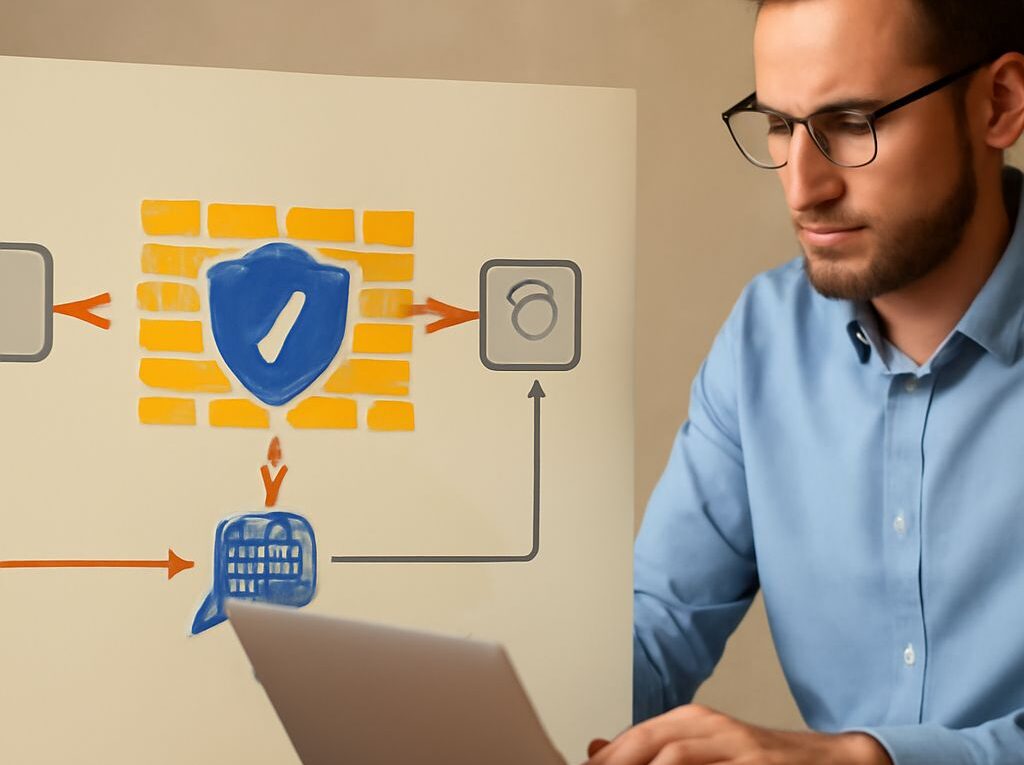
Network Security From the Edge to the Endpoint
A branch firewall may block unwanted internet traffic while an unmanaged field device still has broad access to internal systems. To secure the network, the organization must follow the connection from the external edge to each destination and assign an owner to every control. Network operations and security teams need a shared view of that path, including remote users and cellular links.
The work begins with an inventory and a map of legitimate traffic. Identify critical services, devices, users, external connections and business consequences if each becomes unavailable. That record makes it possible to set priorities and to notice connections that no one can explain.
Network and Security Responsibilities Along the Path
At the edge, the network and security teams identify exposed services and approve only the connections the business needs. Firewalls and filtering rules reduce unnecessary exposure, while a documented owner reviews changes and removes obsolete rules. The edge is also where carrier circuits and cellular gateways enter the design; backup connections need the same review as primary links.
Securing internal networks requires clear boundaries. Inside the site, segmentation limits which devices can communicate. For example, payment terminals, employee laptops and building sensors can occupy separate zones, with only the necessary flows permitted between them. VLANs provide separation when designed and enforced appropriately, but a label alone is not an access policy. An owner must approve the paths, implement the rules and check that changes do not interrupt required work. CISA’s infrastructure hardening guidance describes segmentation and restricted management access as parts of a layered approach. Accessed November 19, 2026.
For remote access, use an organization-managed gateway or other approved access service, strong authentication and permissions limited to the user’s task. A contractor who maintains one application should not automatically reach every branch subnet. Security staff define access requirements; service owners approve the need; administrators provision and remove permissions when the engagement ends.
Protect the device and observe the result
The security of the network also depends on the device at the end of a connection. Managed computers and supported gateways need maintained software, appropriate endpoint protection and an inventory that identifies their owners. Where a sensor cannot run endpoint software or receive frequent updates, restrict its allowed connections and document the exception. The device owner and security team should agree on compensating controls and a review date.
Monitoring turns controls into evidence. Collect relevant gateway, authentication and endpoint events in an approved location, synchronize clocks and define retention and access rules. Networking and security personnel should agree on which alerts require action, who receives them and how an incident is escalated. A sudden change in device traffic or repeated authentication failures may warrant investigation; neither alone proves a compromise.
Updates require planning as well. Track software versions and support dates, assess vendor advisories, test changes where practical and schedule deployment according to risk and operational impact. For remote sites, prepare a rollback and an out-of-band support route when available. An unpatched router may remain reachable while weakening the controls around every connected device.
Prepare to restore service
IT network security includes recovery as well as prevention. Maintain protected configuration backups and an inventory of dependencies, then test restoration with the people responsible for the service. Recovery plans should name priorities, decision makers and communications channels. NIST’s guide to cybersecurity event recovery connects resource priorities with realistic recovery planning. Accessed November 19, 2026.
The next step for both teams is to map one critical service from its external connection to its endpoint, including its backup path. For each boundary, record the allowed traffic, control owner, monitoring and recovery method. Address the most consequential unowned or untested gap first, then repeat the exercise for the next service.