How Do Fiber Optic Cables Work?
Fiber optic cables are at the core of modern communication, enabling the rapid and reliable transfer of vast amounts of data across cities, countries, and even continents. Understanding how do fiber optic cables work involves examining the science of light transmission through ultra-pure glass strands, the specific cable structure, and the technology’s numerous advantages for network infrastructure. This article explains the principles behind fiber optics, how data is transmitted using light, the essential components of fiber optic cables, and why these cables are crucial for high-performance private wireless networks.
The Basics of Fiber Optic Technology
Fiber optic technology uses strands of glass or plastic, each thinner than a human hair, to transmit data in the form of light pulses. These cables have revolutionized telecommunications by offering much higher bandwidth and lower signal loss compared to traditional copper cables.
At its core, how does fiber optic work relies on the concept of total internal reflection. When light enters one end of the cable, it bounces repeatedly along the length of the fiber without escaping, thanks to the precise structure and composition of the glass. This property enables light signals to travel long distances with minimal loss, making fiber optics ideal for high-speed data transmission.
Fiber optics are widely used in internet backbones, long-distance phone lines, local network infrastructure, and specialized applications like medical imaging and industrial sensing. Their efficiency and reliability have made them the preferred choice wherever high-speed, high-capacity data transfer is essential.
How Light Transmits Data Through Fiber Optic Cables
Data transmission in fiber optic cables begins with converting electrical signals into light using a laser or LED. This light, typically in the infrared spectrum, is sent into the fiber optic strand. Information is encoded onto the light—often by turning it on and off in rapid sequences—representing the binary data of digital communication.
Once inside the fiber, the light travels by repeatedly reflecting off the internal walls of the core. The glass core is surrounded by a layer called the cladding, which has a lower refractive index. This difference ensures that the light stays contained within the core through total internal reflection, even as the cable bends or twists along its route.
At the receiving end, specialized detectors convert the light pulses back into electrical signals. These signals are then processed by network equipment, computers, or other devices. The process happens at extremely high speeds, allowing fiber optic networks to handle vast volumes of data for services like streaming, cloud computing, and real-time communications.
This architecture minimizes signal degradation from electromagnetic interference, a problem common with copper cables, and enables data to travel over distances of up to 100 kilometers or more without the need for frequent signal boosting.
Key Components of a Fiber Optic Cable
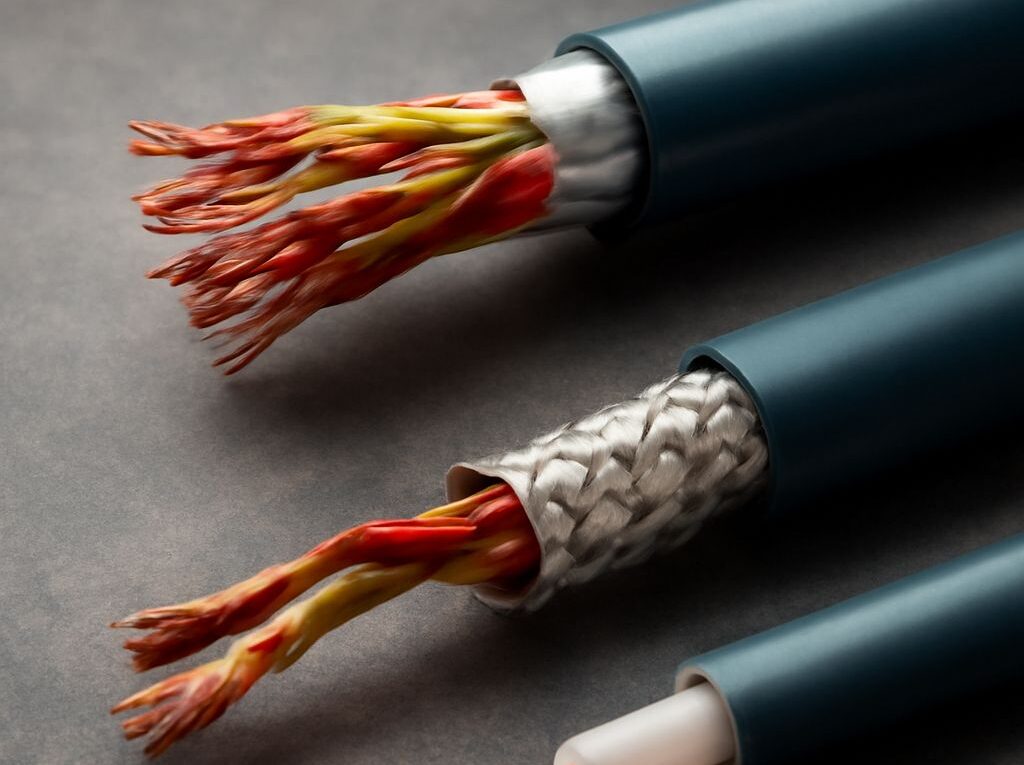
The performance and reliability of fiber optic cables depend on their precise construction. The main components are:
- Core: The thin central region made of ultra-clear glass or sometimes plastic, where light signals travel. The core’s diameter typically ranges from 8 to 62.5 microns, depending on whether the fiber is single-mode or multi-mode.
- Cladding: A glass layer surrounding the core with a lower refractive index. This crucial difference keeps the light confined to the core by causing it to reflect back inward rather than escaping.
- Buffer Coating: A protective plastic layer that shields the core and cladding from moisture, physical damage, and chemical exposure.
- Strength Members: Materials such as aramid yarn (e.g., Kevlar) are added to provide extra durability and tensile strength, protecting the delicate glass fibers from stretching or breaking during installation and use.
- Outer Jacket: The final protective sheath, made of tough plastic, that guards against environmental hazards and provides structural integrity.
These components work together to ensure that fiber optic cables are robust, flexible, and suitable for a wide range of installation environments, from underground conduits to aerial deployments and inside office buildings.
Benefits of Fiber Optic Cables in Private Wireless Networks
Fiber optic cables offer distinct advantages for private wireless networks, which are increasingly used by businesses, campuses, factories, and smart city projects seeking secure and high-performance connectivity.
First, fiber optics provide exceptional bandwidth, supporting the heavy data loads required by advanced wireless applications such as IoT devices, video surveillance, and real-time analytics. The low latency of fiber ensures that wireless networks remain responsive and efficient, even during periods of peak demand.
Second, fiber optic cables are immune to electromagnetic interference, which is crucial in environments with heavy machinery, radio equipment, or high-voltage installations. This immunity ensures continuous, disturbance-free data transmission, enhancing the reliability of mission-critical wireless systems.
Finally, fiber optics facilitate network scalability and future-proofing. As wireless technologies evolve and data demands increase, fiber infrastructure can accommodate upgrades without the need for wholesale replacement, supporting the long-term growth and adaptability of private wireless networks.