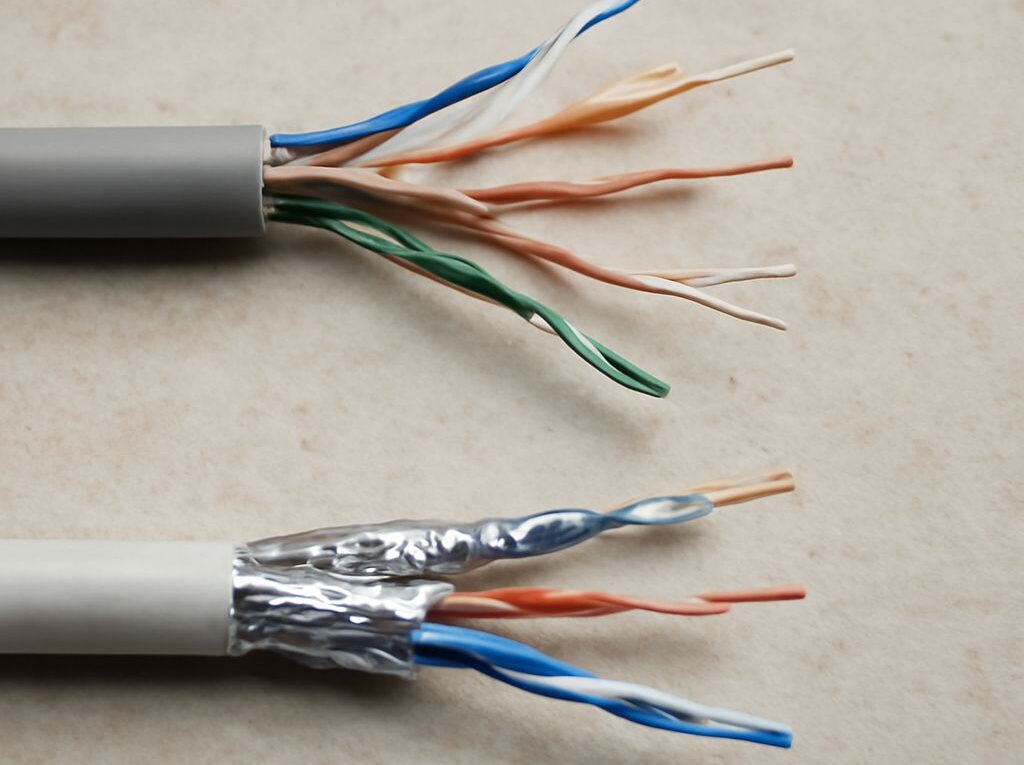
RJ45 Color Codes for Shielded Cat6 Cable: What to Buy and How to Terminate
Shielded Cat6 is worth buying only when the full channel can stay shielded and bonded from end to end. The cable, plugs, jacks, patch panel, rack, and grounding path all need to match; otherwise the shield adds cost without adding much benefit.
For most buyers, the safe path is to turn the purchase into a specification checklist first, then terminate the link with the correct RJ45 color codes. That prevents the most common mistakes: buying copper-clad aluminum, choosing the wrong jacket rating, mixing shielded and unshielded hardware, or grounding only one piece of the run.
When shielded Cat6 is the right choice
When shielding helps
Shielded Cat6 cable makes sense in places with electrical noise, dense cable bundles, long parallel runs near power, LED lighting, motors, VFDs, elevators, or industrial equipment. It is also a practical choice where PoE loads are high and the installer wants extra margin against interference and alien crosstalk.
It is most useful in a complete channel that stays shielded through the jack, patch panel, patch cord, and equipment port. If the run ends in an unshielded connector or a floating shield, the noise benefit drops sharply.
When to skip it
Shielding is usually unnecessary for a short home run, a simple office patch lead, or a clean low-noise environment where standard Cat6 already meets the need. It is also a poor choice when the installer cannot verify grounding, cannot source matching shielded hardware, or needs the simplest possible termination process.
If the grounding path is unknown, unshielded Cat6 is often the safer and easier purchase. Shielding only pays off when the whole link is designed for it.
Why the grounding path matters
A shield is not a standalone upgrade. It must have a defined path from the cable shield to the connector shell, then through the patch panel or jack to the rack or enclosure, and from there to the building grounding system. That continuity is what drains interference instead of trapping it.
Any break in the chain can reduce performance or create a floating shield. A mixed link that uses shielded cable with plastic jacks, unshielded couplers, or non-bonded patch panels does not provide the same result as a fully grounded shielded channel.
What to check before you buy Ethernet cable
Conductor material and pair construction
For permanent runs, buy solid bare copper conductors, typically 23 AWG for Cat6. Avoid copper-clad aluminum, often listed as CCA, because it does not meet the same electrical and mechanical expectations and can fail compliance, PoE, and termination goals.
Check that the cable is true twisted pair with four distinct pairs and that the listing states whether it is solid or stranded. Solid cable is for in-wall or structured runs; stranded cable is for flexible patch cords. The plug must match the conductor type.
Jacket rating, category marks, and length
The jacket should match the installation path. Common markings include CM for general-purpose indoor use, CMR for riser spaces, and CMP for plenum spaces. Some installs also call for LSZH or other regional flame/smoke requirements.
Look for clear Cat6 or Category 6 markings on the jacket and packaging, along with the conductor gauge, shielding type, and a length mark that matches the reel or pull box. For buying decisions, the useful question is not only where to buy ethernet cable, but where to buy cable with printed specifications that can be verified after delivery.
Buy a little more length than the measured run. Extra slack helps with routing, dressing at the patch panel, and preserving the pair twist at the termination point. Underbuying length often leads to tight bends and rushed terminations.
Shield type, grounding path, and seller specs
Shielded Cat6 comes in several constructions, such as foil around each pair, a global foil shield, a braid, or a combination. The exact type matters because it affects flexibility, termination style, and connector choice. The listing should say whether the cable is F/UTP, S/FTP, SF/UTP, or another defined shield format.
When deciding where to buy Ethernet cable, prioritize structured-cabling distributors, electrical wholesalers, and network supply sellers that publish complete specs. A good listing should state:
- conductor material and gauge
- solid or stranded construction
- shield type
- jacket rating
- category and compliance marks
- outer diameter, if shielded plugs will be used
- length, color, and package format
- return terms and warranty details
Marketplace listings can work only when the seller specification is detailed and consistent with the cable jacket. If the ad does not name the conductor, shield, and jacket rating, the purchase is risky.
What proof to save for a return
Before the box is opened, save the product page, order confirmation, SKU, and photos of the packaging labels. After delivery, photograph the jacket printing, the cable end label, and any compliance marks before cutting the spool or opening bulk packs.
Keep evidence of any mismatch between the advertised and actual cable: a missing category mark, a CCA marking, a different shield type, or the wrong jacket rating. Those details matter if the cable must be returned or rejected on inspection.
RJ45 color codes and the hardware that matches
T568A wire order
T568A and T568B both work for Ethernet. The choice is about standardization, not speed. The important rule is to use one standard consistently on both ends of the same straight-through cable.
- Pin 1: white/green
- Pin 2: green
- Pin 3: white/orange
- Pin 4: blue
- Pin 5: white/blue
- Pin 6: orange
- Pin 7: white/brown
- Pin 8: brown
T568A is common in some government and residential work. If a building standard already exists, match it.
T568B wire order
T568B is widely used in commercial and patch-panel installations. The pair positions differ from T568A, but the cable still works the same when the same pattern is used at both ends.
- Pin 1: white/orange
- Pin 2: orange
- Pin 3: white/green
- Pin 4: blue
- Pin 5: white/blue
- Pin 6: green
- Pin 7: white/brown
- Pin 8: brown
For a straight-through cable, do not mix T568A on one end and T568B on the other unless a crossover is specifically required. Most modern switches and endpoints auto-detect, so crossover wiring is rarely needed.
Shielded plugs, jacks, and patch panels
Use shielded RJ45 plugs with cable size and conductor type that match the cable. A plug designed for stranded patch cord will not terminate solid conductor correctly. For field-terminated permanent links, many installers prefer shielded keystone jacks and a shielded patch panel rather than crimping plugs on bulk cable.
The hardware should create metal-to-metal contact from the cable shield to the connector shell. A shielded jack or patch panel with a plastic faceplate defeats the purpose if the shield cannot bond through the assembly.
Patch cords should also be shielded if the permanent link is shielded. Leaving a shielded cable connected by unshielded cords creates a weak point in the channel.
Ground, terminate, and certify the link
Bond the shield end to end
Terminate the shield the way the hardware is designed to do it: clamp the foil or braid under the connector’s shield, then bond the connector shell to the jack, patch panel, or equipment chassis. The chassis must have a real grounding path, not just a metal look.
One unshielded coupler, adapter, or patch cord can interrupt the continuity. For that reason, shield continuity should be planned before the first termination, not fixed afterward.
Preserve the pair twists
Keep each pair twisted as close to the contacts as possible. Excess untwist weakens the link and can create crosstalk problems. A practical target is to preserve the twist up to the termination edge and avoid exposing more than about 13 mm, or 0.5 in, of untwisted conductor where possible.
Dress the pairs into the jack or plug without flattening the cable or forcing sharp bends. Cat6 performance depends on pair geometry as much as on conductor quality.
Test continuity and certification
At minimum, run a wiremap test to confirm that the RJ45 color codes land on the correct pins, with no opens, shorts, reversals, or split pairs. For shielded cabling, also verify shield continuity from end to end.
For a permanent link, a certification tester is the best proof that the install meets Cat6 channel limits for length, attenuation, return loss, and crosstalk. The finished result should show correct pinout, intact shielding, proper grounding, and a channel that passes the expected Cat6 standard for the installed length.