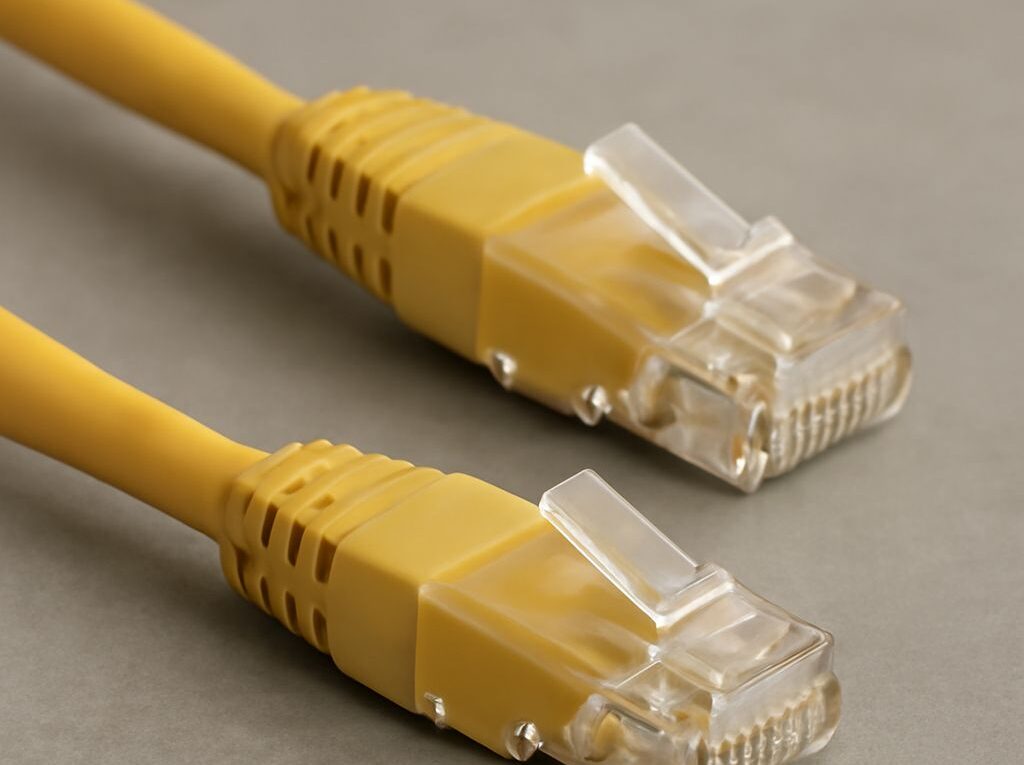
Gigabit SFP, Ethernet Cable Reach, and a Fiber-Optic Modem
A gigabit SFP choice starts with the required reach and the interfaces available at both endpoints. For a copper run, a 1000BASE-T SFP uses an RJ45 jack and Category 5e or better twisted-pair cable, with a maximum 100 m channel. For longer links, an optical SFP uses a defined wavelength and fiber type; common gigabit options reach from several hundred meters over multimode fiber to 10 km over single-mode fiber.
A fiber-optic modem, ONT, and media converter perform different jobs. An SFP is only the pluggable transceiver in a compatible switch, router, or converter. The correct selection therefore depends on the host port, link standard, cable or fiber, connector, peer device, and the type of service handoff.
Gigabit SFP: choose 1000BASE-T copper or optical by reach
Use a copper gigabit SFP when both endpoints are close enough for structured Ethernet cabling and the host device supports an RJ45 SFP module. A 1000BASE-T module converts the SFP slot’s electrical interface to twisted-pair Ethernet. It normally requires Category 5e, Category 6, or better cable and supports 10/100/1000 Mbps negotiation according to the module and host implementation.
Use an optical SFP when the link exceeds the copper channel limit, passes between buildings, needs electrical isolation, or already uses fiber infrastructure. Common choices include:
- 1000BASE-SX: An 850 nm multimode optic, commonly reaching up to 550 m on suitable OM2, OM3, or OM4 fiber. Legacy OM1 installations have shorter limits.
- 1000BASE-LX: A 1310 nm optic designed primarily for single-mode fiber and commonly rated up to 10 km. Some installations use it over multimode fiber with the prescribed mode-conditioning equipment.
- 1000BASE-BX: A bidirectional single-fiber link. The two ends use complementary wavelengths, such as 1310 nm and 1490 nm, so a matched pair is required.
The host must support the selected module and speed. An SFP cage does not guarantee support for every SFP transceiver, and an SFP+ cage may accept a gigabit SFP only when the switch, router, or network operating system supports 1 Gb operation in that slot. Vendor coding, firmware, auto-negotiation behavior, and supported diagnostics can also affect compatibility.
The peer at the far end must use a compatible optical standard. A 1000BASE-SX module should pair with another suitable 1000BASE-SX module over multimode fiber; it should not be paired with a 1000BASE-LX module merely because both are rated at 1 Gb. For copper, the far-end port must support 1000BASE-T or another compatible Ethernet interface.
How long can an Ethernet cable be? 100 m per channel, including patch cords
How long can an Ethernet cable be? For gigabit Ethernet over balanced copper, the standard planning limit is a 100 m channel, including patch cords and the permanent installed cable. A typical design allows up to 90 m for the permanent link and up to 10 m total for patch cords, equipment cords, and the connecting hardware at both ends.
This is a channel limit, not simply a 100 m measurement of cable purchased from a spool. Patch panels, wall outlets, couplers, and patch leads all consume part of the allowable channel. A 90 m in-wall run with 10 m of patch cords is within the usual design, while a 100 m in-wall run plus patch cords exceeds it.
Category 5e is the minimum common cabling category for 1000BASE-T. Category 6 and Category 6A can improve noise margin and support faster standards under the appropriate installation rules, but they do not make an ordinary gigabit copper channel unlimited. Cable quality, bend radius, termination, electromagnetic interference, and nearby power equipment can cause errors before the nominal distance is reached.
When the endpoints are more than 100 m apart, the practical choices are to place an active switch or repeater within the copper limit, or change the long segment to fiber. Passive couplers and extra patch cables do not extend the Ethernet reach. A copper SFP remains subject to the same channel constraints as a built-in RJ45 port because the physical medium is still twisted-pair cable.
Match the optical standard, module, wavelength, fiber, connector, peer, and diagnostics
Optical compatibility is an end-to-end decision. Before purchasing a gigabit SFP, verify each item below:
- Standard and speed: Confirm whether the link is 1000BASE-SX, 1000BASE-LX, 1000BASE-BX, or another approved standard. Both ends must support the intended data rate and signaling.
- Host support: Check the switch, router, firewall, or media converter for supported SFP types, speed modes, coding requirements, and maximum optical reach. A physically fitting module can still be unsupported.
- Wavelength: SX normally uses 850 nm, LX commonly uses 1310 nm, and BiDi pairs use complementary transmit and receive wavelengths. The wavelength must suit the fiber and the peer optic.
- Fiber type: Select multimode fiber, such as OM2, OM3, or OM4, for a compatible short-reach multimode optic. Select single-mode fiber, such as OS1 or OS2, for long-reach LX or BiDi links. The module’s data sheet sets the usable distance.
- Connector: Gigabit SFPs commonly use duplex LC connectors for two-fiber links. BiDi modules normally use a single LC connector. The connector on the patch cable, panel, and module must match, and the fiber polarity must be correct.
- Peer module: The far-end optic must have a compatible standard, wavelength arrangement, fiber type, connector, and optical budget. BiDi modules must be installed as the correct complementary pair.
- Diagnostics: If troubleshooting matters, check whether the host and module support DOM or DDM. These functions can report temperature, voltage, transmit power, receive power, and module alarms, but the available readings depend on both the transceiver and host.
Optical distance ratings are maximums under specified conditions, not a guarantee that every link will work at that distance. Connector loss, splice loss, patch-panel loss, dirty end faces, and the fiber’s attenuation must fit within the module’s optical power budget. A short link can also be unsuitable if a long-reach optic launches more power than the receiver is designed to accept; follow the manufacturer’s short-link guidance where provided.
Complete compatibility example
Consider two switches in separate buildings 2 km apart. Each switch has an SFP slot, and the installed path is OS2 single-mode fiber with two strands and duplex LC patching. A suitable design is one 1000BASE-LX, 1310 nm, single-mode SFP in each switch, with the same Ethernet speed and compatible host support at both ends. The two fibers are connected with the correct transmit-to-receive polarity, and the total connector and splice loss remains below the pair’s optical budget.
A 1000BASE-SX module would not be the correct substitute for that design because it is a multimode, short-reach optic. A 1000BASE-BX pair would also be unsuitable unless the path contains one strand and the two complementary BiDi wavelengths are deliberately selected.
Fiber-optic modem, ONT, or media converter: follow the Ethernet handoff
The incoming service determines which optical termination is needed. A fiber-optic modem is often a consumer-facing description for equipment that presents an internet connection from a fiber service, but the precise device may be an ONT or another provider-specific unit.
- ONT or ONU: An optical network terminal terminates a passive optical network such as GPON or XGS-PON. It communicates with the provider’s optical line terminal, handles the provider’s access protocol, and commonly presents Ethernet to the customer through an RJ45 port. Some ONTs also include routing, Wi-Fi, voice, or television functions.
- Media converter: A media converter changes one Ethernet physical medium to another, such as 1000BASE-T RJ45 to an optical SFP. It is normally used for a point-to-point Ethernet link and does not authenticate or terminate a provider PON. It may require a separately selected SFP.
- SFP module: An SFP is a transceiver that fits into a compatible network device. It provides the electrical-to-optical or electrical-to-copper interface for that host, but it is not an ONT, router, or general-purpose fiber service termination.
The handoff can therefore take several forms. A provider fiber may enter an ONT and leave as one-gigabit Ethernet through an RJ45 port; that Ethernet cable then connects to the router’s WAN port. An ONT may instead provide an SFP-based Ethernet handoff, in which case the receiving router or switch must support the supplied optical module and the provider’s required configuration. A private point-to-point fiber run may bypass an ONT entirely and use an optical SFP in each switch, or use a media converter at one or both ends.
For example, a home or office receiving a gigabit RJ45 handoff from an ONT can connect that port to a router WAN port with a Cat5e patch cable. The cable is only one channel segment and remains within the 100 m copper limit. If the ONT is in another building 2 km away and the service is delivered as Ethernet over OS2 fiber, the customer-side equipment needs compatible 1000BASE-LX optics or a media converter pair; an ordinary copper SFP cannot connect directly to the incoming fiber.